

Why Transportation Is the Silent Cause of Turnover, No-Shows, and Overtime in Central Virginia Workforces
Most attendance problems don’t start with a bad employee.
They start with a car that didn’t.
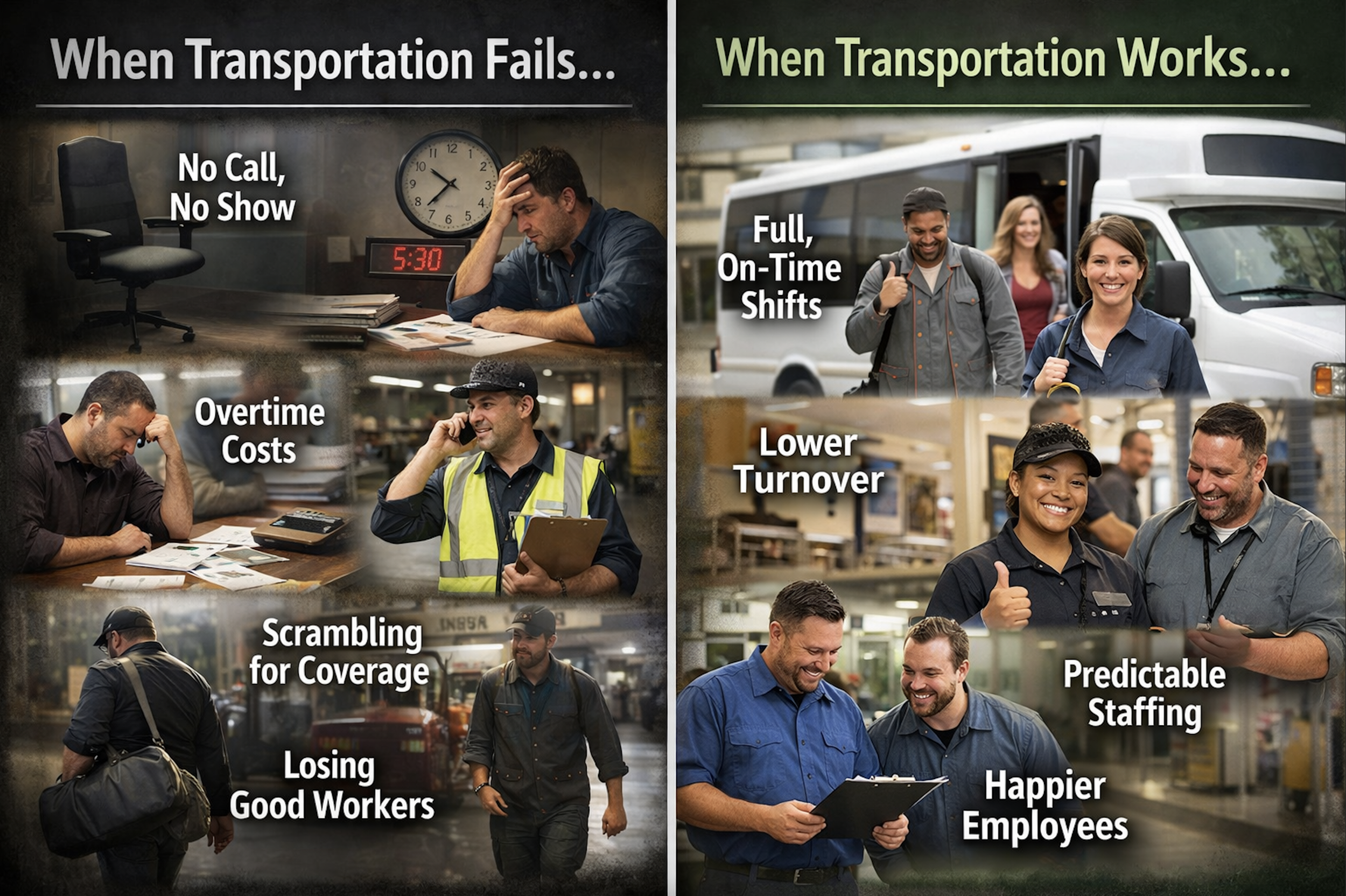
Comparison of workforce disruptions caused by unreliable transportation versus reliable employee shuttle service.
The Problem No One Wants to Admit
Across Central Virginia, employers are fighting the same daily battle:
Employees who want to work but can’t get there reliably
Morning shifts delayed by last-minute call-outs
Supervisors scrambling to cover gaps
Overtime costs quietly creeping higher
Good employees leaving—not because of the job, but because getting to the job became impossible
Transportation breakdowns are rarely listed as the official reason for turnover or absenteeism.
But in practice, they are one of the most common—and most expensive—points of failure in hourly and shift-based operations.
Cars break down.
Licenses lapse.
Ride-sharing disappears at 5:30 a.m.
Carpools fall apart without notice.
And when that happens, the operational consequences land squarely on management.
A Reality Employers Know All Too Well
If this sounds familiar, you’re not alone—and it’s not a management failure.
Most employers are already doing everything right:
Competitive wages
Flexible scheduling
Attendance policies
Recruitment incentives
Yet none of those solve the underlying problem when an employee simply cannot get to work.
For supervisors, it becomes exhausting:
Constant texts and calls before shift start
Last-minute coverage decisions
Reassigning workloads
Fielding frustration from reliable staff who are asked to “pick up the slack again”
For HR and leadership, the frustration is deeper:
Training investments lost
Attendance write-ups that feel unfair
Turnover that looks preventable—but isn’t
Transportation sits in a blind spot between “personal responsibility” and “business operations.”
And because it lives in that gray area, it often goes unaddressed.

Employee transportation challenges in Central Virginia and the impact of reliable shuttle service.
A Practical, Employer-Controlled Solution
Employer-sponsored employee transportation removes that blind spot.
At its core, this is not about buses or vans.
It’s about eliminating a single, recurring operational risk.
A professionally managed employee shuttle:
Provides predictable, scheduled transportation
Operates on fixed or flexible routes based on where employees live
Is driven by trained, insured, and compliant drivers
Removes liability from employee carpools or informal solutions
Gives management control over one of the biggest variables in attendance
Instead of reacting to transportation failures, employers gain a system.
Instead of hoping employees “figure it out,” transportation becomes part of workforce infrastructure—just like payroll or scheduling.
What Changes After Transportation Is No Longer the Problem
The difference is felt quickly—and across the organization.
For supervisors
Fewer pre-shift emergencies
More consistent headcounts
Less time spent solving ride problems
More time focused on operations and people
For HR and leadership
Improved retention among otherwise strong employees
Lower overtime driven by absenteeism
Fewer attendance-related disciplinary issues
A stronger recruitment message: “Reliable transportation provided”
For employees
Reduced stress
Greater reliability
Increased loyalty to an employer who solved a real problem—not just talked about it
Over time, something subtle but powerful happens:
Transportation stops being a daily crisis—and becomes invisible.
That’s the goal.
Why This Matters in Central Virginia
In our region, many of the most essential employers operate:
Early mornings
Late nights
Weekends
Multiple shifts
Public transportation is limited.
Ride-sharing is inconsistent outside peak hours.
And many employees live outside immediate job centers.
This makes transportation reliability a structural issue—not an individual one.
Employers who recognize this early gain an advantage:
More stable staffing
Lower churn
Stronger culture
Better operational predictability
Transportation Is Not a Benefit. It’s Infrastructure.
Employee transportation isn’t a perk.
It’s a risk-management decision.
It’s not about doing more for employees—it’s about removing a point of failure that costs time, money, and morale every single week.
When transportation works, everything else works better.

